Skip to content

Cart

Your cart is empty

Article: Co-factors – why vitamins and minerals are essential for metabolism

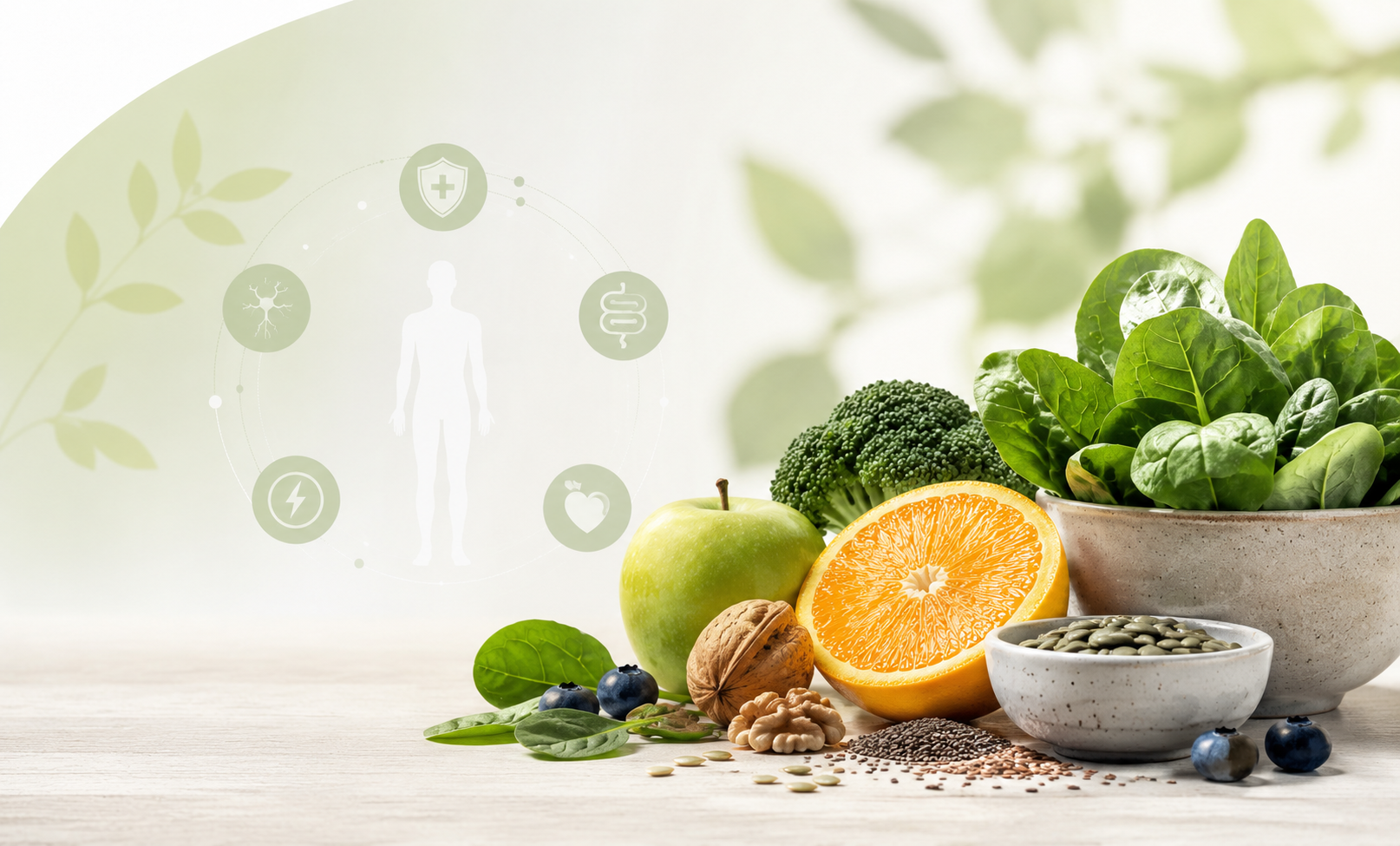
Frisches Obst, Gemüse, Nüsse und Samen als natürliche Quellen für Vitamine, Mineralstoffe und Co-Faktoren für eine ausgewogene Ernährung und einen normalen Stoffwechsel.
Supplements

Co-factors – why vitamins and minerals are essential for metabolism

Vitamins and minerals are often associated only with a balanced diet. In reality, however, they perform far more tasks: they are involved in countless metabolic processes and enable the smooth interaction of many enzymes in the body. For this reason, they are also frequently referred to as co-factors. Diamine oxidase also requires specific co-factors to perform optimal enzyme function.

But what exactly are co-factors and what tasks do they perform in human metabolism?

What are co-factors?

Co-factors are substances that enzymes need to perform their work. Many of these co-factors are vitamins or minerals that the body cannot produce itself and must therefore regularly obtain through diet.

The best-known include, among others:

  • Vitamin B6
  • Vitamin C
  • Zinc
  • Copper
  • Magnesium
  • Iron

An adequate supply of these micronutrients helps ensure that numerous metabolic processes can run normally.

What tasks do co-factors perform?

Co-factors are involved in almost all areas of metabolism. Among other things, they support:

  • normal energy metabolism,
  • normal function of the immune system,
  • protection of cells from oxidative stress,
  • normal function of the nervous system,
  • normal protein and glycogen metabolism, as well as
  • numerous enzymatic reactions throughout the body.

Since the body cannot store vitamins and minerals indefinitely, regular intake through diet is particularly important.

Vitamin B6, Vitamin C and Zinc – important micronutrients

Some vitamins and minerals play a particularly important role in metabolism. These include, among others, vitamin B6, vitamin C, and zinc.

Vitamin B6

Vitamin B6 contributes to

  • normal energy metabolism,
  • normal nervous system function,
  • normal protein and glycogen metabolism, as well as
  • normal immune system function.

Vitamin C

Vitamin C contributes to

  • normal immune system function,
  • protection of cells from oxidative stress,
  • the reduction of tiredness and fatigue, as well as
  • normal collagen formation.

Zinc

Zinc contributes, among other things, to

  • normal immune system function,
  • protection of cells from oxidative stress,
  • normal DNA synthesis, and
  • normal acid-base metabolism.

Diet remains the most important foundation

A varied diet provides not only vitamins and minerals, but also dietary fiber and numerous secondary plant compounds. Vegetables, fruit, whole grain products, legumes, nuts, and seeds form the basis for a good micronutrient supply.

Fresh fruit, vegetables, nuts and seeds as natural sources for vitamins, minerals and other micronutrients as part of a balanced diet.

In everyday life, however, this is not always successful. Professional stress, travel, or a one-sided diet can lead to fewer nutrient-rich foods being on the menu. Dietary supplements can therefore be a useful addition to a balanced diet – however, they do not replace it.

Co-factors in the context of histamine

People dealing with the topic of histamine often also come across the enzyme diamine oxidase (DAO). DAO is involved in the breakdown of histamine from food and therefore plays an important role for many affected by histamine intolerance.

In addition to a conscious diet and individual histamine management, many affected individuals rely on suitable dietary supplements. HISTAmed® DAOpur was developed specifically for consumption before histamine-rich meals. Additionally, HISTAmed® Co-Factors contain selected micronutrients such as vitamin B6, vitamin C, zinc, and copper. Scientifically proven health claims approved by the European Union are available for these nutrients. These include, among others, contributions to normal energy metabolism, normal immune system function, and the protection of cells from oxidative stress.

Conclusion

Co-factors are indispensable components of numerous metabolic processes. They enable the interaction of many enzymes and perform important tasks for energy metabolism, the nervous system, and the immune system. A balanced and varied diet remains the most important foundation for a good supply of vitamins and minerals.

Those who delve more deeply into the topic of histamine will find, alongside HISTAmed® DAOpur, HISTAmed® Co-Factors as well as further information regarding histamine, DAO, and histamine management at HISTAmed®. This allows expert knowledge and suitable products to be combined in one place.
DAO explained simply

Literature

[1] "Histamine – Wikipedia". Accessed: October 11, 2023. [Online]. Available at: https://de.wikipedia.org/wiki/Histamin

[2] M. at DocCheck, "Biogenic amine", DocCheck Flexikon. Accessed: October 11, 2023. [Online]. Available at: https://flexikon.doccheck.com/de/Biogenes_Amin

[3] "Histamine and histamine metabolism - an overview | FETeV". Accessed: October 13, 2023. [Online]. Available at: https://fet-ev.eu/histamin/

[4] O. E. Guttentag, "Histamine and histamine-like substances in the blood", Naunyn-Schmiedebergs Arch. Exp. Pathol. Pharmakol., vol. 162, no. 6, pp. 727–738, Nov. 1931, doi: 10.1007/BF01864146.

[5] O. B. Reite, "Comparative physiology of histamine", in Physiological reviews, 1972, pp. 778–819. [Online]. Available at: https://doi.org/10.1152/physrev.1972.52.3.778

[6] "Pseudoallergies". Accessed: October 24, 2023. [Online]. Available at: https://www.allergiezentrum.org/de/allergien/pseudoallergien

[7] C. A. Akdis and F. E. R. Simons, "Histamine receptors are hot in immunopharmacology", Eur. J. Pharmacol., vol. 533, no. 1–3, pp. 69–76, March 2006, doi: 10.1016/j.ejphar.2005.12.044.

[8] E. K. Roßbach, "INAUGURAL – DISSERTATION to obtain the degree of Doctor of Veterinary Medicine - Doctor medicinae veterinariae - (Dr. med. vet.)".

[9] I. Mota, W. da SILVA, and J. F. Fernandes, "The inhibition of mast cell damage and histamine release in anaphylaxis by pyridine and diphosphopyridine nucleotidase inhibitors. Comparison with compound 48/80", Br. J. Pharmacol. Chemother., vol. 15, no. 3, pp. 405–409, Sep. 1960, doi: 10.1111/j.1476-5381.1960.tb01263.x.

[10] "Benzodiazepines, hypnotics, hypnotica, sedatives, sedative, hypnotic, chemistry". Accessed: October 31, 2023. [Online]. Available at: http://www.welt-der-wappen.de/Apotheke/Hypnotica/hist.htm

[11] "BIOCHEMICAL TREATMENT: MEDICINES FOR THE NEXT CENTURY". Accessed: October 26, 2023. [Online]. Available at: http://superiorsites3.com/NNS91BiochemTreatment.htm

[12] R. Jarisch, Histamine intolerance - Histamine and seasickness. Georg Thieme Verlag, 2013.

[13] "Histamine receptors". Accessed: October 13, 2023. [Online]. Available at: https://www.spektrum.de/lexikon/biologie/histaminrezeptoren/32036

[14] W. F. Ganong, Textbook of Medical Physiology: Human Physiology for Medical Students and Physicians, 4th rev. ed. Berlin [u.a.]: Springer, 1979. [Online]. Available at: https://ubdata.univie.ac.at/AC00290534

[15] "Histamine intolerance - diagnosis and treatment", Health Portal. Accessed: October 13, 2023. [Online]. Available at: https://www.gesundheit.gv.at/krankheiten/stoffwechsel/nahrungsmittelunvertraeglichkeit/histaminintoleranz.html

[16] "Causes of hives". Accessed: November 9, 2023. [Online]. Available at: https://www.nesselsuchtinfo.de/ursachen/mastzellen-histamin

[17] D. T. Weigl, "DoktorWeigl explains histamine & histamine intolerance.", DoktorWeigl. Accessed: November 10, 2023. [Online]. Available at: https://www.doktorweigl.de/krankheiten/histamin-histaminintoleranz-ursachen-symptome-therapie-586/

[18] E. Beubler, ed., "Histamine, serotonin and eicosanoids", in Compendium of Pharmacology: Common Drugs in Practice, Vienna: Springer Vienna, 2007, pp. 41–48. doi:10.1007/978-3-211-72333-3_9.

DISCOVER MORE ARTICLES ON HISTAMINE INTOLERANCE, NUTRITION, GUT HEALTH, AND A CONSCIOUS LIFESTYLE.

MORE KNOWLEDGE FOR YOUR WELL-BEING

Histamin verstehen: Wirkung, Aufgaben und Zusammenhang mit Histaminintoleranz
Histamin

Understanding histamine: effects, functions, and the connection to histamine intolerance

Histamine is an important messenger substance in the body that influences the immune system, the nervous system, and digestion, among other things. Learn how histamine is produced, what functions i...

Read more
Titelbild mit stilisiertem Darm, verschiedenen Milchsäurebakterien und natürlicher Umgebung als Symbol für Probiotika, Mikrobiom und die Vielfalt der Bakterienstämme.
Darmmikrobiom

Probiotics: Why the diversity of bacterial strains is important

Why do some probiotics contain many different bacterial strains, while others deliberately opt for a reduced formula? In this article, you will learn what characterizes multi-strain or broad-spectr...

Read more