
Understanding histamine: effects, functions, and the connection to histamine intolerance
THE BIOCHEMISTRY BEHIND HISTAMINE
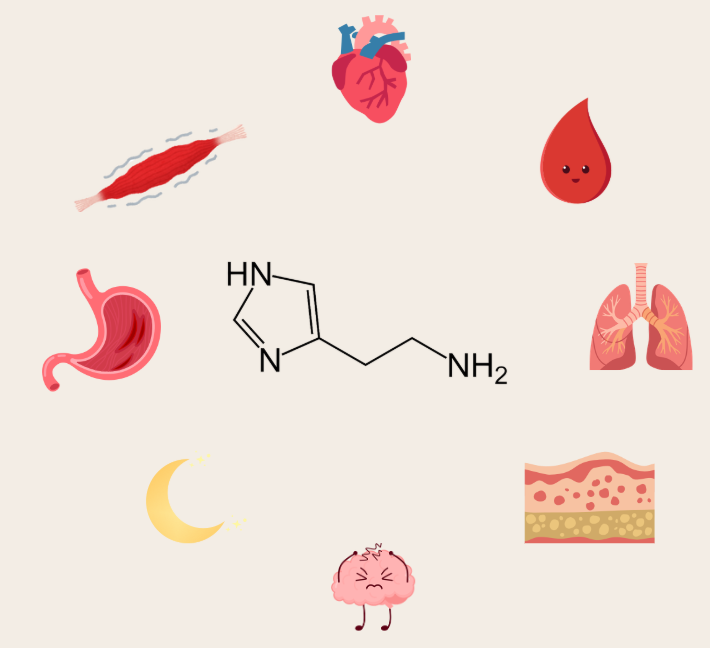
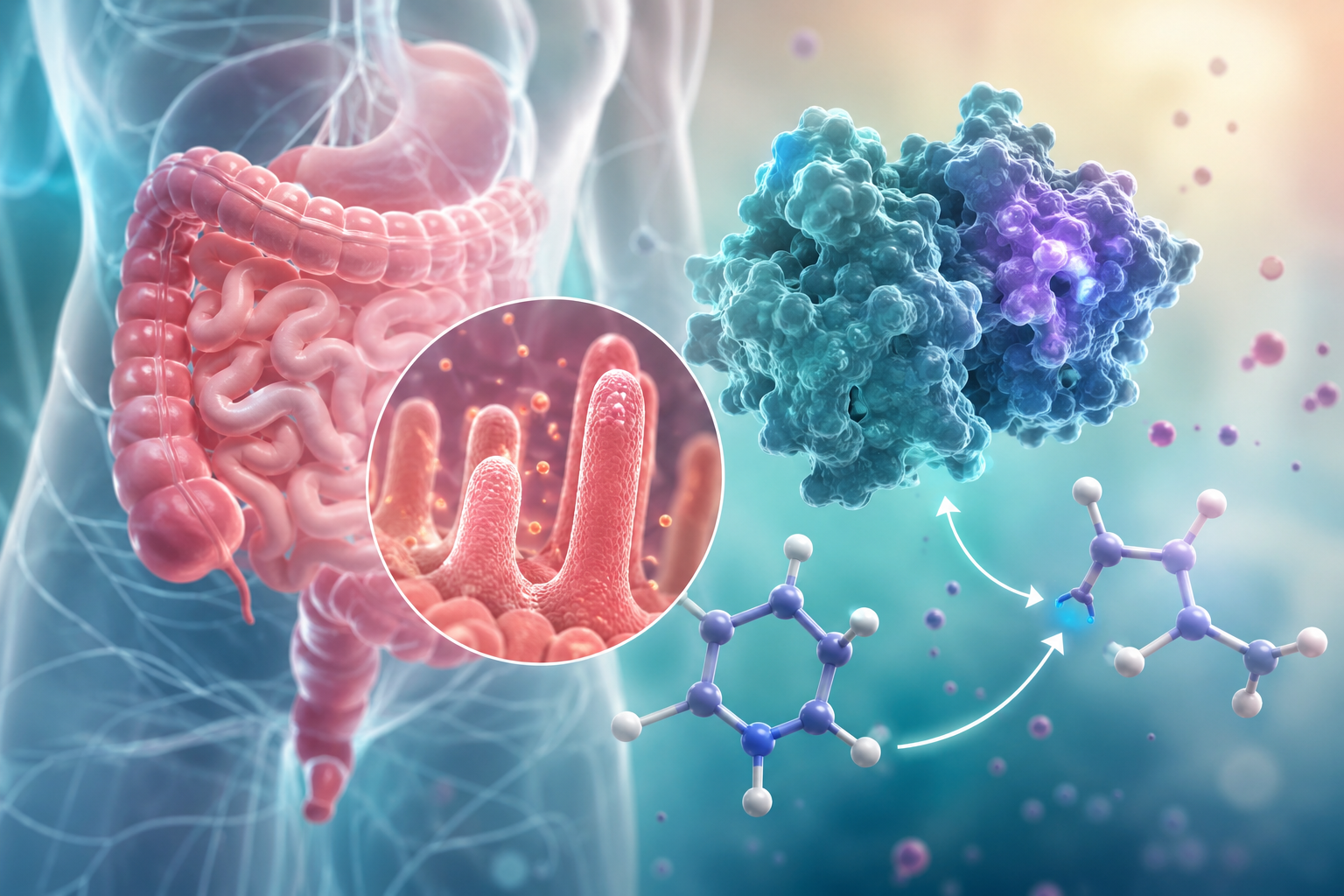
Histamine is a natural signaling molecule that bears the chemical name 2-(1H-4-imidazolyl)ethanamine. The molecule consists of an imidazole ring and a chain with two carbon atoms. An amino group is attached to the carbon chain as a functional group. Histamine is a derivative of the amino acid histidine. In the body, histamine is synthesized biosynthetically by the enzyme histidine decarboxylase. Histamine is formed by the elimination of carbon dioxide from the carboxyl group of histidine (Figure 1).

Histamine is synthesized in cells of the immune system, the skin, the gastric and intestinal mucosa, and the central nervous system (CNS) [1]. It is a biologically active biogenic amine. These types of molecules act in the body as neurotransmitters, cofactors (contributing to biochemical reactions), or hormones [2]. Thus, they are essential for all organisms. The molecule is formed primarily during fermentation or maturation processes and is therefore also found in many plant-based
foods [3]. This poses a significant hurdle if the enzyme diamine oxidase (DAO) is not sufficiently available and a vegan or vegetarian diet is followed. In his 1931 studies, Otto Ernst Guttentag was able to show that in a healthy multicellular organism, no histamine can be detected within the biological detection limit of 100 ng [4]. If this detection limit is exceeded, for example if the enzyme DAO is not present in sufficient quantities, certain symptoms can occur. In lower vertebrates, more histamine is formed here than in higher mammals [5].
THE TASKS OF HISTAMINE IN THE BODY
Histamine was discovered in 1912 and was identified as a signaling molecule for allergic and pseudoallergic reactions. Pseudoallergic reactions occur when allergic symptoms arise, but no allergy-specific antibodies are formed [6]. As mentioned, histamine serves, among other things, as a neurotransmitter, cofactor, or hormone. Since it thereby exerts various effects in the body, it also fulfills different tasks in the various body compartments. Therefore, an increased concentration has varying effects depending on the body region. It has central effects on the brain, the gastrointestinal tract, and the immune system. As a biogenic amine, histamine binds to membrane proteins of cells. So far, four different docking receptors are known. They have been named in the order of their discovery and bear the names H1, H2, H3, and H4 receptors. The receptors differ in how they process histamine when it binds to them, and in how strongly they can bind to histamine [7]. In the body, histamine is primarily stored in the cells of the immune system. In peripheral tissues, it has been detected mainly bound to heparin in the granules of mast cells and basophilic granulocytes [8]. Eosinophilic granulocytes, platelets, and enterochromaffin cells serve as additional storage sites (mast cells, basophilic granulocytes, and platelets are different blood cell types involved, among other things, in immune reactions; enterochromaffin cells are hormone- and neurotransmitter-producing cells in the intestinal mucosa) [9]. In Figure 2, the release of histamine from cell types with high histamine storage is shown graphically. The mode of release is of particular importance here. The histamine released from basophilic granulocytes and nerve cells, for example, binds to the H1 receptor, whereas histamine from enterochromaffin cells binds to the H2 receptor.
HISTAMINE INTOLERANCE
A histamine intolerance is nothing more than an excessively high histamine level that the body cannot reduce itself through metabolic processes. Dr. Carl Pfeiffer coined the term histadelia for this [11]. Histamine has an influence on many biochemical processes. A significant problem here is the intolerance towards many pain-relieving medications, such as diclofenac or acetylsalicylic acid (active ingredient of aspirin). These active ingredients promote histamine release, which can worsen symptoms in allergy sufferers [12]
EFFECT ON THE CENTRAL NERVOUS SYSTEM (CNS)
In the CNS, histamine acts as a neurotransmitter and regulates by binding to presynaptic H3 receptors. As a result, it is also involved in the release of other neurotransmitters. Influencing reactions include the regulation of the sleep-wake cycle, body temperature, and memory. However, the transduction mechanism of this reaction has not yet been clarified [13]. The degradation of histamine in the CNS occurs primarily through methylation (attachment of a carbon atom bound to three hydrogen atoms) by the enzyme histamine-N-methyltransferase. It can then be broken down and excreted via the urine [8].
EFFECTS ON THE SKIN
Histamine intolerance can also manifest on the skin, often in the form of hives, wheals, sudden redness, or itching [14] [15]. The reason for this is that the immune system classifies substances as threats that are actually not threats. In the case of histamine, it is released excessively by mast cells, which serve to detect and defend against potential threats. Through activated H1 receptors and an associated increased permeability of blood and lymph vessels, fluid can accumulate in surrounding tissues, causing wheals to form. Thus, among other things, the typical symptoms of an allergy are mediated [13]. Stimulation of nerve endings also causes itching [16].
HISTAMINE IN THE GASTROINTESTINAL TRACT
In the gastrointestinal tract, histamine docks to H2 receptors. Increased gastric acid production can occur because the enzyme adenylate cyclase is activated. In these cases, however, a higher histamine concentration is needed [13]. Since histamine also has an influence on smooth muscle, an increased histamine concentration can affect movement patterns in the stomach and intestines, thereby disrupting digestion [17].
HISTAMINE IN THE IMMUNE SYSTEM AND REGULATION OF BLOOD PRESSURE
Histamine also plays a significant role in the bloodstream. Since it has an influence on smooth muscle, among other things, undesirable effects can also occur here. With an increased concentration of histamine in the blood, blood vessels are dilated via H1 receptors, which ends in an increased heart rate. Additionally, the ejection volume of histamine is promoted via H2 receptors, whereby the concentration increases further [18].


ethanamine.%20The%20molecule%20consists%20of%20an%20imidazole%20ring%20and%20a%20chai...)